
Article

Understanding the Avian Respiratory System: Barrier Risks and Relief Strategies
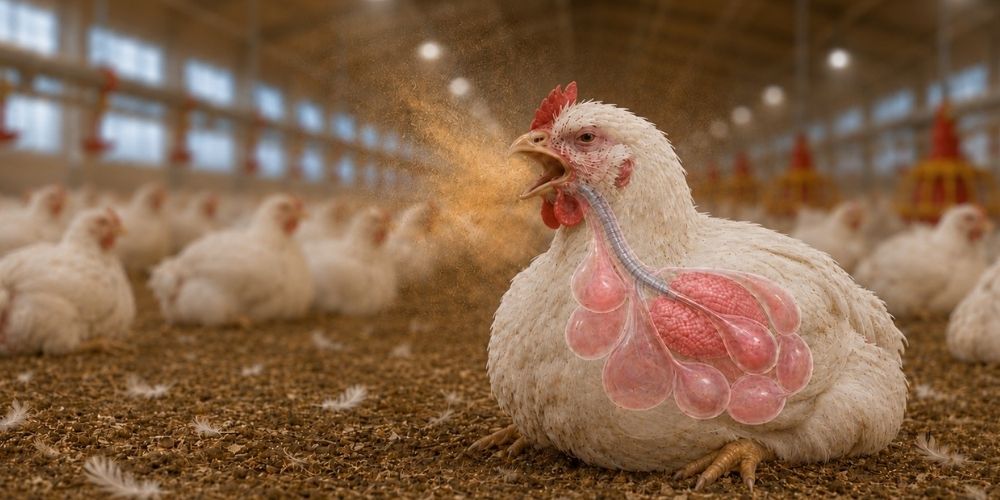
In poultry production, the avian respiratory system is both a biological advantage and a management challenge. Birds breathe through a highly efficient system built on unidirectional airflow and multiple air sacs, allowing rapid oxygen exchange to support growth, activity, and thermoregulation.
However, in high-density commercial farms, the same efficiency can become a dangerous shortcut for pathogens, dust, and ammonia. Once contaminated air enters the respiratory tract, it can travel deep into the system and repeatedly expose sensitive lung structures. This is why maintaining respiratory barrier health is not just disease control—it is daily flock protection.
Avian Respiratory System: Structure & Risks
.jpg)
The avian respiratory system is composed of the trachea, lungs, and a network of air sacs distributed throughout the body. Unlike mammals, which use tidal ventilation, birds rely on air sacs to move air through their rigid lungs, allowing airflow to pass continuously across the gas-exchange surface.
This design creates highly efficient ventilation and oxygen exchange, but it also increases exposure to airborne challenges. When air quality is poor or pathogens are present, dust, ammonia, and infectious agents can contact the respiratory surface repeatedly and move deeper into sensitive tissues. Understanding this unique structure helps explain why poultry are especially vulnerable to respiratory disease.
This design creates highly efficient ventilation and oxygen exchange, but it also increases exposure to airborne challenges. When air quality is poor or pathogens are present, dust, ammonia, and infectious agents can contact the respiratory surface repeatedly and move deeper into sensitive tissues. Understanding this unique structure helps explain why poultry are especially vulnerable to respiratory disease.
Unidirectional Airflow & Air Sacs
One of the most important features of the avian respiratory system is unidirectional airflow. In mammals, air moves in and out through the same pathway, and fresh air mixes with used air inside the lungs. In birds, airflow is more like a one-way ventilation system. The air sacs distributed throughout the body act as bellows, helping push air through the lungs in a continuous direction.
This efficient respiratory design allows poultry to exchange oxygen rapidly, supporting fast metabolism, active movement, and stable thermoregulation. However, this high efficiency also creates a trade-off. Airborne pathogens, fine dust, and irritating gases can move deeper into the respiratory tract as air passes rapidly through the system.
Although the parabronchi and air capillaries provide a large surface for gas exchange, their delicate structure is highly sensitive to contaminated air, increasing the risk of irritation, inflammation, and infection over time. This makes good air quality and proper house management essential for protecting the avian respiratory system.
Anatomical Weakness: No Diaphragm
Another unique feature of avian anatomy is the absence of a diaphragm. In mammals, the diaphragm separates the thoracic and abdominal cavities and supports the mechanical process of breathing. In poultry, breathing is driven mainly by body wall movement and the coordinated expansion and compression of the air sacs, rather than by lung expansion.
Because the air sacs are widely distributed throughout the body, the respiratory tract is closely connected to many internal regions. Once pathogens break through the respiratory mucosa, they may spread beyond the upper airway and reach deeper structures, including the lungs, air sacs, and nearby tissues. The avian respiratory system is not just a breathing pathway; it is an internal ventilation network, and contamination in one area can quickly become a broader health challenge.
Avian Respiratory Barrier: Lines of Defense
Physical Barriers: Mucociliary Escalator
The mucociliary escalator serves as the first protective layer of the avian respiratory system. Along the respiratory tract, mucus captures dust, bacteria, viruses, and other airborne particles, while tiny cilia move these trapped materials upward and outward for clearance. This continuous cleaning process helps keep the airway open and reduces the chance of pathogens reaching deeper respiratory tissues.
Although this defense system appears simple, it plays a critical role in respiratory protection. In a well-managed flock, the mucociliary escalator works like a self-cleaning conveyor, continuously removing trapped particles from the airway. However, high ammonia levels can impair or damage cilia and stimulate excessive mucus production. When this happens, trapped particles are no longer cleared efficiently. Dust-carrying bacteria may remain on the mucosal surface or move deeper into the lungs and air sacs. Once this physical barrier is weakened, pathogens have a greater opportunity to invade deeper respiratory tissues.
Biochemical & Cellular Defense Mechanisms
If pathogens move beyond the mucus and cilia, cellular immunity becomes the next line of defense. At this stage, immune cells help identify, engulf, and remove invading organisms. However, the avian respiratory system has a unique limitation: compared with mammals, healthy avian lungs contain relatively few resident macrophages along the respiratory surface. As a result, poultry depend heavily on the rapid recruitment of heterophils, the avian equivalent of neutrophils, to support early immune defense.
This immune response can be weakened when birds are exposed to stress. Heat stress, cold stress, crowding, transport, and disease pressure can increase corticosterone levels, potentially suppressing immune cell activity and weakening early defense coordination. When mucociliary clearance and cellular immunity are both compromised, even common airborne pathogens may lead to more severe respiratory signs.
Factors Compromising Avian Respiratory Barriers
Because of this unique design, respiratory barrier protection depends heavily on mucus quality, effective ciliary movement, and a well-coordinated immune response. When these defenses are compromised, poultry become more susceptible to infection and inflammation, and flock performance may decline. Several major factors can break the respiratory barrier, especially ammonia, dust, environmental stress, and respiratory pathogens. These factors often interact, placing continuous pressure on the respiratory barrier.
Ammonia and Dust Hazards
In poultry houses, ammonia is mainly produced when microorganisms break down uric acid and other nitrogen-containing compounds in manure and wet litter. Poor ventilation, high litter moisture, and excessive stocking density can all accelerate ammonia accumulation in poultry houses. Ammonia levels around or above 20–25 ppm can irritate the respiratory tract, damage tissues, and reduce flock comfort. Prolonged exposure, even at lower levels, may gradually weaken the respiratory mucosa.
The main danger of ammonia is not only its smell. Ammonia can impair ciliary movement, stimulate excessive mucus secretion, and damage the respiratory lining. Poultry house dust further adds to the challenge, as it may carry feed particles, litter debris, feathers, microorganisms, including bacteria. When the mucociliary barrier is weakened, these dust-borne contaminants can move deeper into the avian respiratory system, increasing the risk of airsacculitis, secondary bacterial infection, and uneven flock performance.
Climate and Environment Stress
Birds are warm-blooded animals, but the house environment strongly influences their body temperature and respiratory function. Sudden temperature changes, cold drafts, heat stress, and poor humidity control can all challenge the respiratory mucosa. When the temperature drops sharply, blood vessels in the mucosal surface may constrict, reducing local blood flow and slowing the arrival of immune cells. Under heat stress, birds increase panting to release body heat, which can alter airway moisture and make the respiratory surface more vulnerable to irritation and damage.
Humidity also plays a key role. Very dry air can thicken mucus and reduce clearance efficiency, while excessive humidity often increases litter moisture, ammonia release, and microbial growth. For poultry respiratory health, stable environmental control is not a luxury; it is frontline prevention.
〈Related Article:Strategic Care for Chicken in Cold Weather: Combating Poultry Viral Diseases〉
Common Pathogen Attacks
Respiratory pathogens can directly damage the mucosa and create entry points for secondary infection. Avian influenza virus (AIV) and Newcastle disease virus (NDV) may infect respiratory epithelial cells, causing inflammation and cell damage; the infection can then spread rapidly within a flock. Once the mucosal surface is damaged, bacteria can more easily attach to and colonize the respiratory tract, increasing the risk of secondary infection.
Mycoplasma gallisepticum (MG) is another major concern. MG can attach to the respiratory epithelium and interfere with ciliary function, reducing the bird’s ability to clear mucus and contaminants. As the respiratory barrier weakens, secondary organisms and environmental stressors may further complicate the condition. Therefore, protecting the avian respiratory system requires control of both infectious and non-infectious triggers.
〈Related Article: Effective Solutions for Preventing and Treating CRD in Poultry with Natural and Conventional Approaches〉
Strengthening Avian Respiratory Barriers
Because poultry face constant exposure to environmental change and pathogen pressure, medication alone cannot fully reduce respiratory risk. A stronger strategy is to protect the barrier before severe disease develops. This means improving air quality, stabilizing temperature and humidity, supporting mucosal immunity, and using nutritional tools that help maintain normal breathing comfort. The goal is not to “rescue” the respiratory barrier after it fails, but to keep it resilient every day.
Poultry House Ventilation and Temperature
An effective ventilation program helps remove excess ammonia, moisture, dust, carbon dioxide, and airborne microorganisms while maintaining a comfortable house temperature. However, ventilation must be carefully balanced. Too little airflow allows ammonia and moisture to accumulate, while excessive cold air movement may lead to chilling and stress.
Producers should regularly measure ammonia levels instead of relying on smell alone. Litter moisture should be controlled through proper drinker management, stocking density, airflow, and bedding maintenance. Maintaining humidity within an appropriate range helps support mucus function and reduce dust levels. Environmental deodorizing agents, litter treatments, or beneficial microbial products may also help reduce ammonia release from manure at the source. A cleaner house environment lowers the burden on the respiratory tract and supports stronger respiratory barrier protection.
〈Related Article: How to Prevent and Control Necrotic Enteritis in Poultry to Boost Farm Productivity〉
Biosecurity and Vaccination
Biosecurity helps reduce pathogen pressure before infectious agents reach the respiratory tract. Cleaning, disinfection, traffic control, water hygiene, rodent control, and all-in/all-out management remain essential. For occupied-house disinfection, producers may consider mild disinfectant strategies, such as slightly acidic electrolyzed water or potassium peroxymonosulfate-based products, based on local regulations, label instructions, and bird tolerance. The goal is to reduce airborne pathogens without irritating the respiratory mucosa.
Vaccination is another key tool for respiratory protection. Eye-drop, nasal-drop, and spray vaccination can stimulate local mucosal immunity in the upper respiratory tract, helping the flock build defense where many respiratory pathogens first contact the bird. Secretory immunoglobulin A (sIgA) is especially important because it can neutralize pathogens on the mucosal surface before they reach deeper tissues. Proper vaccine handling, droplet size, timing, and flock uniformity all affect the immune response. Vaccination cannot replace good management, but it can strengthen the flock’s defense against respiratory infections.
〈Related Article: What is Avian Influenza? Symptoms and Its Impact on the Poultry Industry〉
Vaccination is another key tool for respiratory protection. Eye-drop, nasal-drop, and spray vaccination can stimulate local mucosal immunity in the upper respiratory tract, helping the flock build defense where many respiratory pathogens first contact the bird. Secretory immunoglobulin A (sIgA) is especially important because it can neutralize pathogens on the mucosal surface before they reach deeper tissues. Proper vaccine handling, droplet size, timing, and flock uniformity all affect the immune response. Vaccination cannot replace good management, but it can strengthen the flock’s defense against respiratory infections.
〈Related Article: What is Avian Influenza? Symptoms and Its Impact on the Poultry Industry〉
Nutrition and Immunomodulators
Nutrition supports the structure and function of the respiratory barrier. Vitamin A is important for maintaining epithelial integrity and normal mucus production. When birds face stress or respiratory challenges, antioxidant nutrients, balanced amino acids, and immune-supportive feed additives may help support mucosal repair and immune coordination.
Plant extracts and essential oils are also commonly used as supportive tools. Eucalyptus and peppermint essential oils are valued for their refreshing aromatic profile and their potential to support breathing comfort. Eucalyptol is often associated with anti-inflammatory and airway-supportive effects, while menthol from peppermint may activate cold-sensitive receptors in the upper airway, changing the sensation of airflow and helping birds feel more comfortable. These tools should be used as part of a full program, not as a magic wand. Poultry biology is impressive, but it still refuses shortcuts.
〈Related Article: Effective Solutions to Manage Poultry Heat Stress for Better Health and Farm Productivity〉
Support Smooth Poultry Breathing-Euca-ease®
.jpg)
Euca-ease® from Life Rainbow Biotech is designed to support smooth poultry breathing and help maintain respiratory comfort during environmental and seasonal challenges. Its formula features eucalyptus-derived active compounds, including rich eucalyptol, together with peppermint-based aromatic components. Eucalyptol is valued for supporting a balanced inflammatory response and helping maintain airway comfort. Menthol may activate cold receptors in the upper respiratory tract, influencing the sensation of airflow and respiratory effort. This is why menthol-containing products are commonly associated with relieving upper airway congestion.
〈Product Recommendation:Euca-ease®〉
Avian Respiratory System FAQ
Can avian air sacs develop pneumonia?
Strictly speaking, air sacs do not develop “pneumonia” in the same way lung tissue does. Pneumonia refers to inflammation or infection of the lungs. In birds, infection or inflammation of the air sacs is called airsacculitis. This condition can be difficult to resolve because air sacs have thin walls, limited blood supply, and relatively poor drug penetration. As a result, achieving an effective medication concentration in the affected area can be challenging. When airsacculitis occurs, treatment response may be slow, and recurrence is common if the original cause—such as ammonia, dust, Mycoplasma gallisepticum (MG), E. coli, or viral infection—is not controlled. This is why prevention is so important for the avian respiratory system.
How to tell if the avian respiratory barrier is damaged?
When the respiratory barrier is damaged, birds often show early warning signs before mortality increases significantly. Common signs include frequent head shaking, sneezing, coughing, watery eyes, nasal discharge, open-mouth breathing, gasping, abnormal respiratory sounds, reduced activity, poor feed intake, and uneven flock growth. In layers, egg production or shell quality may also decline during respiratory stress. Producers should also monitor flock behavior. Birds that avoid certain areas of the house may be responding to ammonia, dust, drafts, or poor ventilation. If signs appear repeatedly or spread quickly, veterinary diagnosis is recommended. Because the avian respiratory system can deteriorate quickly, early detection is far more cost-effective than delayed intervention.
〈Related Article: Poultry Respiratory Diseases: Symptoms, Treatment, and Prevention〉
Conclusion
The avian respiratory system is one of the most efficient respiratory systems in the animal world. Its unidirectional airflow and air sacs allow birds to exchange oxygen rapidly and support high metabolic demand. But this same structure also creates a serious vulnerability in commercial poultry production. When ammonia, dust, temperature stress, and pathogens are present, harmful particles can reach deep respiratory tissues and challenge the bird’s natural barriers.
Protecting respiratory health requires a complete program. Ventilation must remove ammonia and dust. Temperature and humidity must remain stable. Biosecurity and vaccination must reduce pathogen pressure. Nutrition and supportive additives must help maintain mucosal integrity and immune readiness. No single product can replace these foundations. Respiratory health should always be managed through a complete program.
Euca-ease® from Life Rainbow Biotech is designed to support poultry breathing comfort and respiratory vitality. Formulated with eucalyptus- and peppermint-derived aromatic compounds, it helps maintain respiratory comfort during periods of environmental and seasonal challenge. For producers seeking practical support for flock comfort and respiratory barrier health, Euca-ease® can be a valuable part of a forward-looking poultry health strategy.
References:
Avian Respiratory System
Relationship of structure and function of the avian respiratory system to disease susceptibility
Air Quality in Alternative Housing Systems May Have an Impact on Laying Hen Welfare. Part I—Dust
Air Quality in Alternative Housing Systems May Have an Impact on Laying Hen Welfare. Part II—Ammonia
Ammonia induce lung tissue injury in broilers by activating NLRP3 inflammasome via Escherichia/Shigella
Effects of Different Ammonia Concentrations on Pulmonary Microbial Flora, Lung Tissue Mucosal Morphology, Inflammatory Cytokines, and Neurotransmitters of Broilers
The Alterations of Tracheal Microbiota and Inflammation Caused by Different Levels of Ammonia Exposure in Broiler Chickens
Mycoplasma gallisepticum Infection in Poultry
Menthol: effects on nasal sensation of airflow and the drive to breathe
Avian Influenza
Robust Unidirectional Airflow through Avian Lungs: New Insights from a Piecewise Linear Mathematical Model

Liferainbow
Life Rainbow Biotech is a manufacturer with R&D of antibiotic-free feed additives. We focus on mycotoxin solution, intestinal pathogen control, immune enhancement and aqueous nutrition supplement.

Article Classification
Recent Articles
- Feed Conversion Ratio (FCR): Formula, Factors, and Ways to Improve Feed Efficiency
- Avian Immune System: Why Balance Matters More Than Immune Stimulation?
- Understanding Coccidiosis: A Threat to Livestock Health
- Understanding the Avian Respiratory System: Barrier Risks and Relief Strategies
- Reproductive System of a Sow and How to Improve Breeding Rates