
Article

Chicken Heat Stress: Signs, Production Effects, and Management
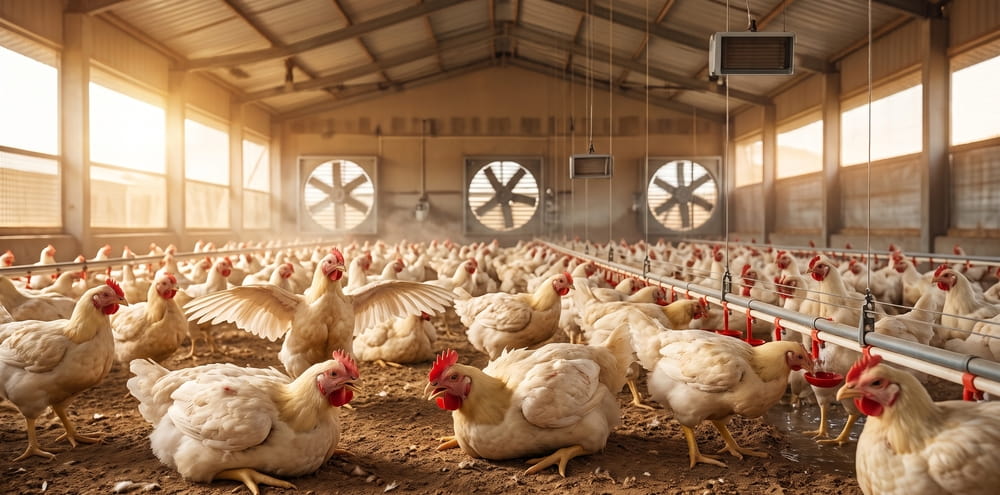
Managing chicken heat stress requires more than simply cooling the environment. Prolonged heat exposure can reduce feed intake while affecting intestinal function, nutrient utilization, egg production, and egg quality. Understanding these effects is the first step toward effective management. From recognizing early signs and production changes to improving environmental conditions and selecting appropriate nutritional support, a comprehensive approach can help birds cope more effectively with hot-weather challenges. Gano-met® can be incorporated as a practical drinking-water nutritional support option during these periods.
What Is Chicken Heat Stress and When Is It a Risk?
Chicken heat stress occurs when the heat a bird produces and absorbs exceeds its ability to dissipate heat and maintain normal body temperature. Unlike humans, chickens cannot rely on sweating to cool down. As environmental temperatures rise, chickens increase heat loss through behavioral and physiological responses such as holding their wings away from the body and panting. Panting promotes evaporative heat loss through the respiratory tract, but prolonged or excessive panting can disturb acid-base balance and increase physiological stress.
〈Related Article: Effective Solutions to Manage Poultry Heat Stress for Better Health and Farm Productivity〉
The risk of chicken heat stress cannot be determined by air temperature alone. Relative humidity affects evaporative cooling, while airflow influences how efficiently birds can dissipate body heat. Age, body size, genetics, stocking density, housing conditions, and acclimation can also affect heat tolerance. As a result, the same environmental temperature may have only a minor effect on one flock but cause noticeable reductions in feed intake and production performance in another.
Heat Stress vs. Heat Stroke in Chickens
Chicken heat stress is sometimes confused with heat stroke in chickens, but heat stroke represents a much more severe stage of heat-related stress. Heat stress describes a broader process, ranging from increased efforts to dissipate body heat to more serious physiological disturbances. Heat stroke can be considered an extreme, potentially life-threatening stage in which normal heat-loss mechanisms are no longer sufficient. Severely affected birds may become weak, poorly responsive, unable to stand, or collapse.
How Heat Stress Affects Feed Intake and Egg Production
Sustained high temperatures commonly reduce feed intake, but lower feed consumption alone does not fully explain the decline in production performance. Heat stress can also affect metabolism, intestinal integrity, nutrient absorption, and oxidative balance. In laying hens, these combined effects may contribute to reduced egg production and changes in egg quality.
Reduced Feed Intake and Egg Production
When temperatures remain high, chickens typically reduce feed intake partly to limit the metabolic heat associated with eating, digestion, and nutrient metabolism. Lower feed consumption reduces the amount of energy, amino acids, minerals, and other nutrients available for production. In laying hens, prolonged heat exposure may reduce laying performance and egg weight and can also affect eggshell quality, including shell strength and thickness.
Gut Health and Nutrient Use
The impact of chicken heat stress extends beyond simply eating less. Heat exposure can affect intestinal morphology, barrier integrity, local immune responses, microbiota composition, and nutrient transport. These changes may compromise normal digestion and nutrient utilization. As a result, even if the diet remains unchanged, the amount of nutrients chickens absorb and effectively use for maintenance and production may be reduced during prolonged heat stress.
〈Related Article: How to Prevent and Control Necrotic Enteritis in Poultry to Boost Farm Productivity〉
Signs of Chicken Heat Stress
Recognizing chicken heat stress early helps producers respond before conditions becomes more severe. Changes in breathing, posture, drinking, feeding, and activity can provide useful early warning signs. As heat stress progresses, birds may become increasingly weak or have difficulty remaining upright, indicating the need for more immediate cooling, adequate water supply, and environmental intervention.
Early Signs of Heat Stress
Early chicken heat stress can often be identified through changes in breathing, posture, water consumption, and feeding behavior. Persistent panting or multiple signs together should prompt an immediate review of house temperature, humidity, airflow, and drinking-water availability, rather than waiting for declines in egg production or growth performance.
- Panting: Chickens increase evaporative heat loss through open-mouth breathing, making panting one of the most common early signs of heat stress.
- Wings held away from the body: Holding the wings away from the body helps increase heat dissipation from the body surface. When this occurs together with panting, it is a stronger indication that the chicken is experiencing increased environmental heat load.
- Drinking more water: Chickens typically increase their water intake during hot weather. Water temperature, flow rate, and drinking-system capacity should be checked to ensure that the entire flock has adequate access to water.
- Eating less: Chickens may reduce feed intake to limit metabolic heat production. This is also an important early sign that nutrient intake and subsequent production performance may begin to decline.
〈Related Article: Understanding the Avian Respiratory System: Barrier Risks and Relief Strategies〉
Severe Signs of Heat Stress
When chickens can no longer dissipate enough heat through their normal cooling responses, heat stress may progress to a more severe stage. Heavy panting, marked lethargy, abnormal posture, or difficulty standing are warning signs of serious heat stress and indicate that immediate cooling and environmental intervention are needed.
- Heavy panting: Persistent, rapid panting indicates that chickens are struggling to dissipate heat effectively. Ventilation and cooling performance should be checked immediately.
- Weakness or lethargy: Noticeable weakness, reduced activity, and decreased responsiveness suggest that the effects of heat stress have progressed beyond mild discomfort.
- Crouching or lying down: Prolonged crouching or lying down may indicate that affected birds are having difficulty maintaining normal activity.
- Difficulty standing or collapse: This is a serious warning sign. Immediate cooling and adequate water supply should be ensured, and veterinary assistance should be sought when necessary.
How to Reduce Chicken Heat Stress?
Reducing chicken heat stress begins with lowering the environmental heat load. Ventilation, airflow, shade, cooling systems, and reliable access to drinking water should come first, followed by feeding adjustments and nutritional support. Feed additives, electrolytes, antioxidants, or other nutritional tools can complement these measures, but they should not be used as substitutes for adequate ventilation, cooling, and water management.
1. Improve Ventilation and Airflow
Ventilation is a key measure for removing excess heat from a poultry house. During hot weather, fans, air inlets, tunnel ventilation systems, and circulation fans should provide sufficient airflow at bird level. Dust buildup, blocked inlets, damaged fans, uneven air distribution, or excessive stocking density can create localized hot spots. Increased air movement supports convective heat loss, particularly when chickens are already holding their wings away from the body. Ventilation should also be coordinated with relative humidity and any evaporative cooling system in use.
2. Keep Drinking Water Cool and Available
During hot weather, chickens usually increase their water intake, which makes water supply, flow rate, and water temperature especially important. Simply confirming that water is present in the tank or drinking line does not mean the flock is receiving enough. Producers should check whether drinkers can provide sufficient flow during peak demand and whether all chickens have easy access to water. Water temperature should also be monitored, as excessively warm water may reduce intake. Regularly checking water pressure, line function, cleanliness, and overall system capacity helps ensure that adequate drinking water is available throughout periods of heat stress.
3. Adjust Feeding During Hot Weather
Feeding management during hot weather should focus on feeding time and maintaining adequate nutrient intake, rather than simply encouraging chickens to eat more. A greater proportion of feed can be offered during cooler periods of the day, such as early morning or evening, when environmental heat load is lower. This helps avoid adding the heat generated by feeding, digestion, and nutrient metabolism to periods of peak environmental temperature. At the same time, actual feed intake should be monitored because prolonged reductions in consumption can limit the energy and nutrients available for growth and egg production.
4. Reduce Environmental Heat Load
Reducing environmental heat load is an important part of managing chicken heat stress, especially in Southeast Asia, where high temperatures are often combined with high relative humidity. In these conditions, reducing solar heat gain and heat accumulation inside the poultry house becomes particularly important. Providing adequate shade, avoiding excessive stocking density, improving roof insulation, and limiting unnecessary heat from lighting or equipment can all help reduce the thermal burden on chickens. Because high humidity can also limit evaporative cooling efficiency, environmental management should focus on reducing multiple heat sources rather than relying on a single cooling method.
5. Use Nutritional Support Strategically
Nutritional support can help chickens cope with the physiological and nutritional challenges associated with chicken heat stress, but it should complement rather than replace basic management such as ventilation, cooling, and reliable water supply. During hot weather, changes in feed intake, electrolyte balance, and oxidative status may increase the need for targeted nutritional support. Electrolytes, vitamins, antioxidants, and other nutritional strategies can be considered according to flock conditions and production goals. The delivery method is also important, because reduced feed intake may affect how much of a supplement chickens actually consume. This makes the choice between feed- and drinking-water-based supplementation particularly relevant during heat stress.
Feed vs. Drinking-Water Supplements for Heat Stress
Both feed- and drinking-water-based supplements can be used during chicken heat stress, but their practical value depends largely on how much chickens actually consume. During hot weather, chickens typically drink more water while feed intake declines, which can directly affect the amount of a supplement they receive through each route. Feed-based products fit well into routine nutrition programs, while drinking-water supplements can often be adjusted more quickly during short-term heat events. The choice should consider actual feed intake, water consumption, response time, and farm management conditions rather than assuming one delivery method is always more effective.
Feed-Based Supplements
Feed-based supplements are well suited to routine nutrition programs because they can be incorporated directly into the diet and used consistently over longer periods. This makes them practical for ongoing nutritional support under normal production conditions. During chicken heat stress, however, feed intake often declines, which means the actual daily amount of a supplement consumed per chicken may also decrease even when the inclusion rate in the feed remains unchanged. For this reason, actual feed intake should be considered when evaluating whether a feed-based supplement can deliver the intended level of nutritional support during hot weather.
Drinking-Water Supplements
Drinking-water supplements can be adjusted more flexibly during short periods of heat stress and may offer a practical advantage when feed intake declines but chickens continue to drink actively. This route can also make it easier to adjust supplementation according to changing flock conditions. However, actual intake still depends on how much water the chickens consume, as well as water quality, water temperature, flow rate, and the capacity of the drinking system. Product solubility and compatibility with tanks, water lines, or dosing equipment should also be considered to ensure consistent delivery throughout the flock.
Feed vs. Drinking-Water Supplements During Heat Stress
| Factor | Feed-Based Supplements | Drinking-Water Supplements |
|---|---|---|
| Typical Use | Routine, continuous nutritional supplementation | Flexible supplementation during short-term or specific periods |
| During Reduced Feed Intake | Intake may decrease as feed consumption declines | Nutritional support can be delivered through drinking water |
| Adjustment | Usually requires coordination with feed formulation or mixing | Easier to adjust on-site as needed |
| Key Considerations | Mixing uniformity and actual feed intake | Solubility, water quality, water consumption, and drinking-water system compatibility |
(Mobile users can swipe the table left and right)
Gano-met®: Ingredients, Dosage, and Practical Use
Gano-met® is a liquid nutritional supplement for poultry containing Ganoderma lucidum fermented extract. Its liquid formulation allows it to be delivered through drinking water, providing a practical option when flexible supplementation is needed during periods of heat stress. The recommended dosage is 1–2 L of Gano-met® per 1,000 L of drinking water, and the product is suitable for poultry of all ages.
As a liquid drinking-water supplement, Gano-met® can be administered directly through the drinking system, allowing rapid delivery to the gastrointestinal tract without relying on feed intake. Its fermented Ganoderma lucidum extract contains naturally occurring polysaccharides and triterpenoids associated with immune regulation, antioxidant activity, and physiological resilience. During heat stress, Gano-met® supports immune balance, antioxidant enzyme activity, inflammatory regulation, and liver detoxification. These combined effects can help chickens cope with environmental and physiological stress, maintain normal function, and support egg production and eggshell quality. Used alongside adequate ventilation, cooling, and water management, Gano-met® can form part of a comprehensive chicken heat stress management strategy.
〈Recommended Product: Gano-met®〉
Chicken Heat Stress FAQs
What are the signs of heat stress in chickens?
Common signs of chicken heat stress include panting, holding the wings away from the body, increased water intake, reduced activity, and lower feed intake. Producers should respond to these early changes rather than waiting until chickens become severely lethargic, unable to stand, or collapse.
What temperature is too hot for chickens?
While 27–29°C (80–85°F) warrants closer monitoring for heat stress, there is no universal threshold. Across tropical and subtropical Asia—including Taiwan and Southeast Asia—summer temperatures routinely reach 30–35°C (86–95°F), accompanied by high relative humidity.
This elevated humidity severely impairs evaporative cooling via panting, hindering thermoregulation. Consequently, flocks can face severe heat-stress risks even at moderately high temperatures. Microclimate airflow, breed, age, body weight, and housing conditions further modulate this vulnerability.
How do you stop chicken heat stress?
The priority is to reduce environmental heat load by improving ventilation, increasing airflow, and providing adequate shade. Chickens should also have continuous access to clean, cool drinking water, while feeding can be shifted toward cooler periods of the day. Electrolytes and other nutritional supplements may be used as supporting measures alongside these basic management practices.
What is the best treatment for heat stress in chickens?
There is no single best treatment for chicken heat stress. The priority is to reduce heat load through cooling, airflow, adequate water supply, and environmental management. Chickens showing severe weakness, prolonged recumbency, or collapse require immediate cooling and may need veterinary attention.
Can chickens recover from heat stress?
Chickens with mild to moderate heat stress can often recover if environmental conditions are improved early and adequate drinking water is provided. Recovery depends on the severity and duration of heat exposure and the condition of the individual bird. Severe weakness, collapse, or persistent abnormal behavior may require more immediate intervention and should not rely on basic management measures alone.
Support Chicken Heat Stress Management with Life Rainbow
Effective chicken heat stress management should address environmental heat load, drinking water, feed intake, and nutritional support together rather than relying on a single product or strategy. Gano-met® provides a flexible drinking-water nutritional support option that can be incorporated into broader heat-stress management programs. Poultry producers, nutritionists, and distributors can contact Life Rainbow Biotech to discuss product specifications, recommended application, and practical use according to flock conditions and farm management needs.
Reference:
A review of heat stress in chickens. Part I: Insights into physiology and gut health
A review of heat stress in chickens. Part II: Insights into protein and energy utilization and feeding.
Impact of heat stress on poultry production
Effect of heat stress on production parameters and immune responses of commercial laying hens
Effect of a probiotic mixture on intestinal microflora, morphology, and barrier integrity of broilers subjected to heat stress.
Acute heat stress induces oxidative stress in broiler chickens.
Broiler water balance and thermobalance during thermoneutral and high ambient temperature exposure.
Integrated Stress Physiology and Mitigation Strategies for Heat Stress in Layer Chickens

Liferainbow
Life Rainbow Biotech is a manufacturer with R&D of antibiotic-free feed additives. We focus on mycotoxin solution, intestinal pathogen control, immune enhancement and aqueous nutrition supplement.

Article Classification
Recent Articles
- The Complete Guide to Sow Management and Feed Additives for Swine
- Chicken Heat Stress: Signs, Production Effects, and Management
- Feed Conversion Ratio (FCR): Formula, Factors, and Ways to Improve Feed Efficiency
- Avian Immune System: Why Balance Matters More Than Immune Stimulation?
- Understanding Coccidiosis: A Threat to Livestock Health